Chinese truck exports reach a new record high
In 2025, China exported 1.06 million trucks, a year-on-year increase of 17.2%. Of these, 908,000 were cargo trucks, a year-on-year increase of 16.7%; and 152,000 were passenger buses, a year-on-year increase of 19.9%.
In December, truck exports reached 112,000 units, a month-on-month increase of 7.3% and a year-on-year increase of 42.4%. Of these, 93,000 were cargo trucks, a month-on-month increase of 2.2% and a year-on-year increase of 37.2%; and 18,000 were passenger buses, a month-on-month increase of 43.5% and a year-on-year increase of 76.6%.
In terms of export destinations, the market structure for heavy-duty truck exports is highly skewed towards developing countries. In November, developing countries accounted for 90.93% of exports, with 31,300 units exported, a year-on-year increase of 61.03%, and demand was entirely focused on fuel-powered heavy-duty trucks (31,100 units exported, a year-on-year increase of 60.84%). Developed countries accounted for 8.93% of exports, with 3,100 units exported, a year-on-year decrease of 9.75%, and demand was also primarily for fuel-powered heavy-duty trucks.
Developing countries (especially those involved in the Belt and Road Initiative) are currently experiencing a period of rapid infrastructure expansion and resource exports. Core transportation scenarios (short-haul mining transport, infrastructure earthmoving, and long-distance resource transportation) demand extremely high "refueling efficiency." However, new energy refueling infrastructure (charging stations, battery swapping stations) in these markets is generally in its nascent stages and cannot support the high-frequency operational needs of new energy heavy-duty trucks. At the same time, the procurement cost of fuel-powered heavy-duty trucks is lower than that of new energy models, fitting the budget constraints of developing countries, making them the absolute preferred choice.
From January to November 2025, Saudi Arabia maintained its position as the leading exporter of heavy trucks with a cumulative export volume of 27,100 units, representing a year-on-year growth of 40.84%. This was only 1,800 units more than the second-ranked Vietnam (25,300 units), with Nigeria following closely behind in third place with 22,400 units. The region covered three core markets: the Middle East, Southeast Asia, and Africa.
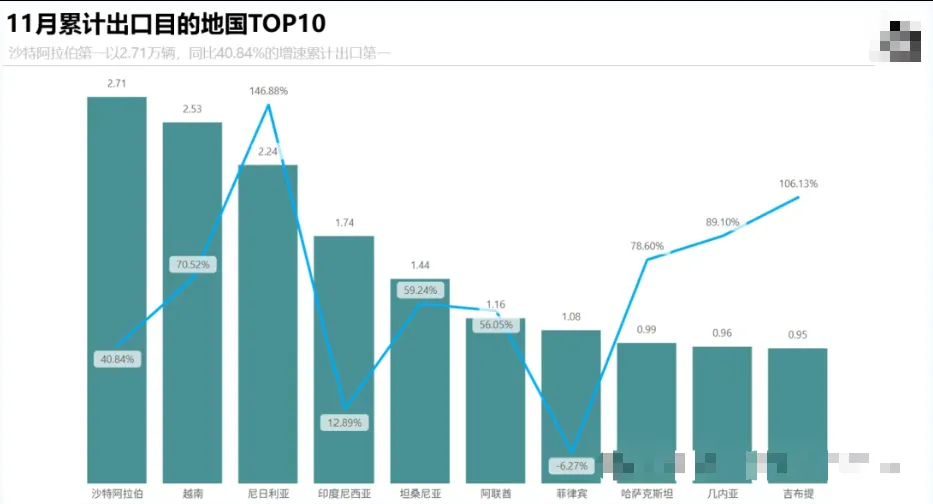
Saudi Arabia's position as the leading cumulative exporter is the result of a long-term combination of "Saudi Arabia's long-term infrastructure planning + adaptation to Chinese heavy truck applications + deep cooperation between China and Saudi Arabia." It is a stable core strategic market. Under Saudi Arabia's "Vision 2030," major infrastructure projects such as the NEOM city, Red Sea tourism projects, port expansion, and railway network construction will be in an intensive construction phase in 2025, ensuring a stable long-term demand for engineering heavy trucks (dump trucks, concrete mixers, and heavy-duty tractors).